Thursday, 7 May 2020

Observation (PS4)

"I swear, Dave - one more 'shiny helmet' gag and you're going straight out the bloody airlock."

As the famous tag line from the film Alien says, “In space, no one can hear you scream.” Which is true, but then it’s also true that no one could hear you play a kazoo, alarm an ombudsman with a powerful erotic dance involving maracas, or emit a ‘bronx cheer’ either.

Obviously, the wording chosen is supposed to evoke a very specific sensation that space is scary, deadly and full of real weird stuff (so essentially, like the middle aisle in Lidl but with fewer discount patio sets) rather than just lacking the requirements to transmit sound. But is space really that scary? It’s basically just full of nothing, and even the titular alien itself is no worse than things you get in Australia – a continent so heaving with lethal fauna it’s a wonder the koala doesn’t have a handgun for an anus. Yet people still happily go there on holiday!

I think the real worry it’s trying to impart is this: fear of being alone.

What with its lack of air, heat, a floor, and branches of Costa, space is a bit rubbish to live in and so very, very few people do – and those that do have to exist sealed up in space stations: essentially giant orbiting caravans where you have to eat baby food, Velcro yourself into bed and poo into a special hoover (mercifully, not simultaneously). 

Should things go awry, having no one around to turn to for help while you float about trapped in a tin box surrounded by literally buggerall is obviously a bit rubbish and scary, and that’s the premise behind Observation; a creepy puzzle solver spewed out by the excellent folks at Devolver.

Malibu


In somewhat of a twist, you play not as the main character of the game – astronaut Emma Fisher, marooned on a damaged space station with a mysteriously absent crew – but as the space station’s AI computer system, SAM. Only you’re not quite yourself and periodically black out and behave oddly, like someone on a hen do activity day who’s been drinking knock-off Malibu since 10am and is now trying to convince a sceptical staff member at a go-karting track that she’s safe to drive despite only being able to see out of one eye.

It’s your job in the periods between being possessed by whatever thing is making you go wonky to help Emma repair the station and find out what the ruddy heck is going on. This is done initially by hopping about the station modules via CCTV cameras, accessing computers and solving logic puzzles. Later, you get a free-roaming drone to control and even have to engage in spacewalks and the like, pooting yourself about on little thrusters.

Being in space, and this being a ‘proper’ space station and not some fancy Star Trek type gaff with artificial gravity that looks more like a dentist’s waiting room than a spaceship, you can move, rotate and float about in all directions freely on any axis. Suffice to say, if this were a VR game it’d probably make you horrendously sick.

As it is, it might take you a while to get used to the fact that what’s ‘up’ when you go into a new area isn’t necessarily ‘up’ for that particular room – disorientation being something real astronauts (and, to be fair, non-space dwelling would-be go-karters who reek of discount coconut liqueur) often struggle with. That can lead to some confusion with puzzles and navigation at first, but once you get your eye in you’ll start thinking much more 3D-ish.
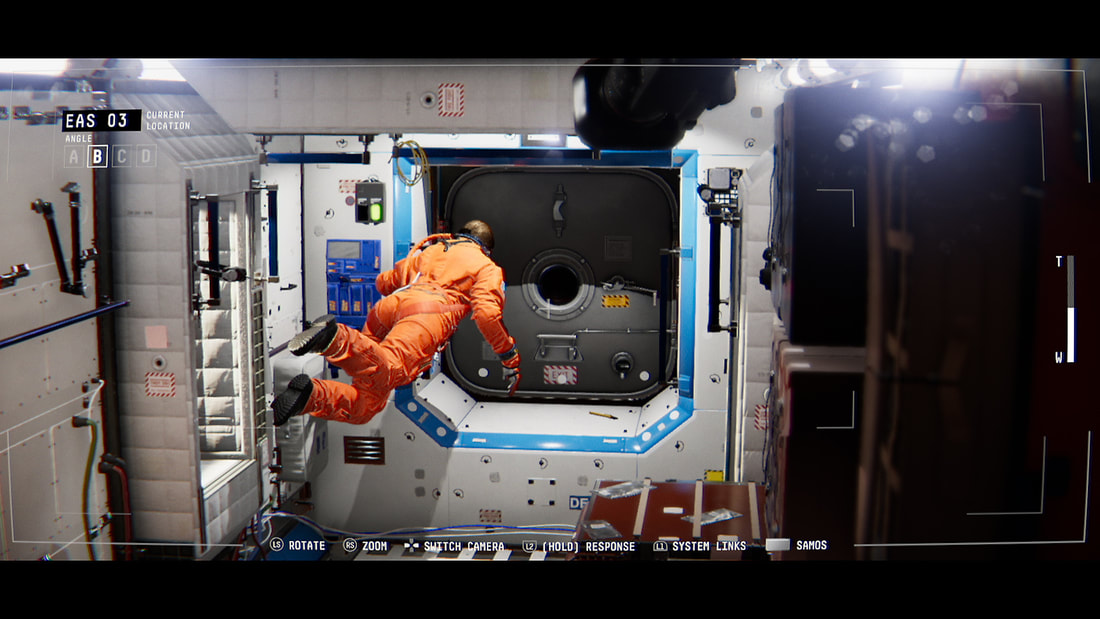
"Oh christ, I'm busting. If this one isn't the toilet I'm going to have to go in my suit. Again."

Violent cousin


It’s all very classic sci-fi in feel, and the stark, claustrophobic, and remarkably realistic space station is a genuinely unsettling place to explore. The game plays out very much like an interactive film – indeed, it only starts proper after you complete a few early tasks and then get a full-blown (and entirely splendid) movie-style title sequence. 

This cinematic feel continues throughout with the use of cut scenes, jump cuts, camera effects and the like, often at unexpected moments that help throw you off balance. It’s a game that’s as watchable as it is playable, and has that rarest of things – a real sense of originality to it. Although there are quite a few explore-o-puzzlers these days, I can’t remember playing anything quite like this. 

In fact, it reminded me most of the old Freescape 3D titles (Driller, Dark Side), or something like the even older Mercenary – exploring a spartan environment with very little immediate threat for the most part, but a definite sense of unease mixed in with the claustrophobia and agoraphobia.

I’m also relieved to say that this doesn’t just collapse into another ‘Jaws in space’ type thing either. Observation thankfully goes in for psychological spookings and high-concept sci-fi rather than outright horror, and there’s no slobbering, violent cousin of ET waiting to pop out of a space cupboard at the end to gnaw on your hapless astronaut’s legs. (That said, now I’ve thought of it Jaws in space would clearly be excellent – get to work, ‘Hollywood’.)

Unfortunate clog


If there are any frustrations to be had, it’s that sometimes the puzzle solutions are a bit too obscure and you can find yourself stuck in an area with no hint of what you’re missing. For example, in one module I was searching for ages for a file containing some information, and it turned out it was on a laptop that I thought I had already checked; there were in reality two different laptops, but the layout of the room was such that this was a really hard spot from the camera angles available.

Similarly, earlier on during a spacewalk I couldn’t find the area to check that the game was obviously asking me to look for, and the identikit sections of the station made working out where I’d looked and where I hadn’t that much trickier to suss out. 

These unfortunate clogs in otherwise pristine puzzle pipes aren’t game killers by a long way, but a patient approach is going to be a necessity in some parts. Again, while there are faster-paced points, on the whole it’s a more slow-burn movie-like mentality. 

But I’d argue that’s no bad thing now and again – after all, what sort of a mindless, vulgarian clot would routinely sit and fast forward through films just to get to action sequences and miss out on all the plot? (Answer: D. Trump does this. I rest my case.)

Even in space, Zoom conferences are compulsory.

Camp robots


While the game is ultimately fairly linear (there’s extra exposition to uncover, but no real branches off of the main story), and won’t take you much longer than 2 or 3 evenings to get through, I’d say it’s well worth your investment. It’s clever, different, and unsettling, and does exactly what it sets out to do exceptionally well. Plus it leaves you thinking without turning into a Kojima-style impenetrable bewilderment fest along the way.

It’s also refreshing to see someone try a sci-fi idea that isn’t a Star Wars knock-off, or a straight ‘kill all non-human life forms’ thing. I suspect I’ve sold a lot of you already on the idea of a more thoughtful, less zappy interstellar experience, but if you’re wavering I’d say this: if you think stories in space begin and end with camp robots, pointy-eared grumps or dudes in saucers with rectal probes, this is well worth a punt to broaden your (event) horizons.


2001 out of 2010


(This review originally appeared on Digitiser 2000 in October 2019)

The Outer Worlds (PC version tested)

"Hello! They call me big chopper. Not because of this knife, but because I ride about on a very large 1970s kids bike! That, and I have crippling elephantiasis of the genitals."

Saying Bethesda are struggling a bit of late (at least quality-wise – financially they’re still lolling about nude in filthy great piles of cash) is an understatement on par with saying questionable perspiration-phobe and unlikely Italian chain restaurant fan Prince Andrew has had ‘a recent dip in popularity’.

Their last few games have been, frankly, dire (Bethesda, that is; A. Windsor might be knocking out homebrew indie bangers on Steam on a weekly basis for all I know), and – as shown by the awful ploy to add an outrageously chonky monthly subscription to the already struggling Fallout 76 – even when they do have a userbase, they’re happy to cram them into the contempt-o-tron and set it to ‘rinse the suckers’.

Essentially, Bethesda are real big poltroons. And The Outer Worlds, made by former collaborators Obsidian (who helmed the splendid Fallout: New Vegas) just underlines quite how far they’ve slid face-first into the slops bin. Mainly by it being ruddy fab, and reminding you what it is you liked about the pre-crap act Bethesda of old in the first place.

Incontinent racist


Set in a future where everything is largely terrible, massively expensive and run by vast, unfeeling companies (“it’s just like today!” etc.), The Outer Worlds sees you as a space colonist waking from an unexpectedly extended cryosleep and shoved into the role of potential revolutionary.

Or: not. Because, as this is a Fallout-style RPG, you can choose the way your character plays and have them be a schmoozing corporate git or Che Guevara in space. Or indeed somewhere in between. You know: like an intergalactic Liberal Democrat.

Your choices affect how the story plays out as you’d expect, and also whether the folk you meet along the way greet you like a long-lost and much-loved family pet unexpectedly returned, or an unwanted extended visit from their accordion-playing Uncle Drunky (who, along with his rampant alcoholism, also happens to be a lewd, incontinent racist, and terrible at the accordion).

Regardless of which route you choose conscience-wise, what then transpires are 1950’s Flash Gordon retro-style space shenanigans across a handful of planets that sees you doing missions, quests, and shooting loads of alien wildlife and enemies with pew-pew ray guns.

Which, let’s be honest, makes The Outer Worlds sound as boilerplate and generic a spacey open-world sci-fi experience as a game can be, and I admit I did have a few worries pre-launch that it’d just be going through the motions. Or, worse still, despite appearances just be a sterile ‘thing’ like the aimless wander/collect gameplay loop of No Man’s Sky at launch. 

But thankfully, while there’s not much new ground being broken here it’s no game design by autopilot either, and this is all down to the execution.

"Don't shoot! Or at least don't shoot me - I have a cool space jacket! She's only got a boring grey jumper. Shoot her!"

Tupperware centaur


The game looks absolutely lovely and runs really well – and by that I mean not only that the shooting and movement are unusually fluid for a more RPG-like experience (it’s still no CoD, but a cut above normal for sure), but also the usual Bethesda/Obsidian bugs that litter the Fallout and Elder Scrolls games are almost entirely absent here.

In fact, because it’s been par for the course for so long it’s almost disappointing to not have your character’s leg suddenly telescope off Inspector Gadget-like into the distance, or to inexplicably find yourself glitched half into a crate to form some sort of monstrous tupperware centaur. But joking aside it does show the extra polish that’s gone on: Obsidian clearly wanted to nail this, and nail it they have.

The biggest strength though is the writing; the dialogue, plotlines and characters are all well written, witty, engaging and memorable. This is essential to the experience, as games like these are always about busywork – take A to B and do C, clear out a weevil infestation from the town farm and so on. What makes the difference is whether it feels like a chore to just get a meaningless exp. point, or whether you’re happy to do menial tasks as you want to help a character and advance their story because you actually care about it/them.

Hitler vs. Gandhi


It also helps that the choices you make are rarely ‘Hitler vs. Gandhi’ scenarios where one is blatantly villainous and the other achingly virtuous: you’ll really have to think about who you want to assist or hinder, why, and what any repercussions might be.

This real-world aping moral uncertainty helps ground things despite the alien setting, as does the fact you can ‘be yourself’, and approach most in-game challenges and your character development in whatever way tickles your sweetbreads.

As you might expect, it’s simple enough to spec for a tough all-rounder who can go in all guns blazing, but like a 1980s action hero’s script your innate stupidity will limit your dialogue options as a consequence. Similarly, you can set yourself up as a slick-tongued stealthist quite quickly, but may struggle with getting shot up the face when caught in gunfights. 

At least, this is the case early on – later, you’ll have exp. points to spare and can easily fill out weaker stats, and it’s this factor that’s probably my main gripe (if you can even call “you get too many abilities” a gripe).

As you stumble towards the endgame (in fact, probably midgame) you’ll find that you’ve levelled up enough to not really be limited much by your earlier choices, and while it’s nice to have a game that doesn’t think a Dark Souls-type grind is ‘the shizz’, I’d recommend at least trying to play it one notch up on difficulty than you normally would. Coasting through is nice in that you know you’ll finish it, but by being a bit too soft and yielding you lose some of the appeal of working to get your character and loadout the way you want them.

Or to put it another way, if you can kill everything with a spoon, unlock doors with a finger, and negotiate your way out of complex scenarios all while only wearing your pants, there’s not really much incentive to root around for guns and armour and invest in specific skills. Or, indeed, even new pants.

Space: where even the rainbows are brown!

Twiddly bits


I think the choice in The Outer Worlds to go in for plot, character and companion depth, and allow for so much variation based on your interactions with the other occupants of the world(s), is absolutely the right one. Rather than some wobbling behemoth like Witcher 3, the value here doesn’t come from sheer size but from replayability – a new run with a differently specced-out character behaving in a different way will feel genuinely fresh.

The Outer Worlds is the strangest thing – it feels like a game we’ve been waiting on for aaaaages, with multiple pretenders to the throne cropping up along the way. And yet it also feels incredibly familiar at the same time, like it has been around as a series for yonks. It just goes to show that doing it right is far more important than doing it online, or bigger, or with more different twiddly bits for the sake of having different twiddly bits.

(Why yes, I do hate tedious, fiddly base building and maintenance – how did you guess?)

Mainly though, it’s great that someone else has taken up the baton that Bethesda has repeatedly dropped down the toilet while drunk, then liberally beaten them about the head with it while shouting “THIS IS HOW YOU DO SINGLE-PLAYER RPGs! DO YOU SEE?”. After all, why still settle for an irradiated wasteland where you can’t even rely on your legs to remain the same length, when now you can reach for the stars instead?


Vault 101 out of Vault 111


(This review originally appeared on Digitiser 2000 in November 2019)

Horace (Steam)

"I hope you're ready to run, as I've forgotten my wallet and can't pay. Also, I've blocked the toilet."

One of the first games I can still clearly remember playing from when I was young wasn’t one of the all-time early arcade classics like Space Invaders or Donkey Kong. It wasn’t even a clunky home version of these, like Pac-Man on the Atari 2600, even though I actually had an Atari 2600 and apparently also had the infamously duff 2600 port of Pac-Man as a photo exists of me playing it one Christmas (its shonky awfulness perhaps being the reason why I’ve blotted it out of my memory).

No, this was an obscure game on the 48k Speccy called Mutant Monty and the Temple of Doom, one of four games on an allegedly now rare (according to some dude on ebay trying to flog a copy) compilation tape called ‘ASSEMBLAGE’. Because, of course, nothing says ‘great new game’ like bundling it on a tape with 3 other unrelated efforts and then giving it an uninspiring collective title that basically means ‘pile of stuff’.

Extra buttock


It was also never clear why Monty was a mutant. Onscreen, he just looked like a normal bloke; well, as normal as you can make anyone look in monochrome 8-bit graphics about 1 cm high. Maybe he had a crippled spleen, or an extra buttock?

Anyway, despite it being mainly remarkable for simultaneously ripping off Monty Mole, Indiana Jones AND (for the game itself) Manic Miner, it lodged itself in my cerebellum for one specific reason – it was the first proper platformer I ever played. It was also memorable to me as it was very, very hard, in that uniquely retro approach to longevity sense of ‘well we can’t make a long game, so we’ll make an unfairly tough one that takes ages to finish instead’.

Playing Horace reminded me of Mutant Monty in a number of ways. Some good. Some…less so.

Sodden


Not so much steeped in nostalgia as absolutely sodden with it to the point it’s standing in a puddle of its own nostalgia and has yet more nostalgia running down its legs, Horace is an old-school pixel art platformer that will be utterly bewildering for anyone from outside of the UK and/or people who were born after about the year 2000, unless they’ve got a serious fetish for old British telly and games.

Observe: it even opens with the old ‘reflection’ Thames TV intro!

Playing as Horace, a robot butler, it’s your job to jump about platforms collecting rubbish. One million bits of rubbish to be precise. This might sound like an awful premise for a game, but wait! It’s also a game about family and belonging, dealing with bereavement, the horrors of war and learning the value of life. All this…in a darkly humorous retro-themed platform game about a brass bin man? Yes, really.

If this looks hard, you're in for a surprise: it is! Also, there's no surprise.

Nude shower scene


You see, like football Horace is a game of 2 halves – the actual ‘playing the game’ bit, which I’ll come onto in a minute, and the glorious, glorious cutscenes. (Also like football, it’s compulsory afterwards to have an awkward, nude group shower with 10 other people who’ve played the game!)

Horace’s story is imparted like a 2D computer-animated film, albeit if they’d animated it on a Mega Drive, all narrated by his slightly melancholy-sounding robotic voice. There are a lot of these exposition interludes interleaved through the game – so many in fact, it’s touch and go whether the game is really the interlude to the story segments. But they’re all beautifully written, and slowly reveal the larger plot through Horace’s somewhat naïve robotic eyes.

I won’t spoil these for you as they make up such a substantial part of the game’s appeal, but they’re by turns funny, sad, heartwarming, and always, always a reminder of days gone (that’s actual days gone, not the recent mediocre PS4 zomb-em-up).

Whether it’s from the games that get mentioned in passing, the pop culture references, or the spoofs and pastiches, you’re never far from a reminder of the developer’s clear love for the 80s era (give or take a few years either way).

Meat gimmick


This isn’t just a gimmick, either – you couldn’t pen a story like this without a genuine affection for the period, and that writing strength comes through in memorable characters you’ll develop a real affection for, and a strong desire to get to the next cutscene to see how the plot develops.

But to do that, you have to play the game. And at this point, I’ll give you a clue as to where this is going with three words: Super, Meat, Boy. Or, in case that means nothing to you, three more words: you, die, alot (yes, I know – shut up).

That’s right, Horace is hardcore. Seriously hardcore. Do you miss the pixel-perfect, start-the-level-again-bang-your-head-on-the-table-from-frustration style of early platformers? Well it’s here tonight, Matthew! All wrapped up in 2019 sheen with fancier abilities such as gravity-shifting boots and SNES mode 7-a-like rotating levels.

Don’t get me wrong – I like a challenge. But it’s fair to say the sort of twitch-reaction platformer where you have to be spot on *all* the time is a niche genre these days rather than the norm, and though Horace isn’t as brutal as some (you do get infinite lives, the odd shield, and the occasional mid-room restart point), it leans a lot more the way of being deliberately punishing for the sake of it than, say, the tough but fair latter levels of a Super Mario outing.

Yes, but have you seen Love Island?

Shiny Willy


Style-wise, the levels also ooze nostalgia. Which is a polite way of saying if they remade a shiny new Jet Set Willy for the 21st century, it’d look like this. Almost EXACTLY like this, in fact. It even has ‘In The Hall Of The Mountain King’ as background music for some areas, and similar baddies in the form of possessed machetes and power drills (albeit with a plot-fitting explanation as to why they’ve sprung to homicidal life).

Really, the whole game – with its uniquely British setting and callbacks, its unusual combination of seriousness and weirdly dark humour, and its rampant eccentricity – is as close to what you’d get if you gave a 1980s bedroom coder like Matt Smith (the Miner Willy guy, not the 11th Doctor Who – not least because in the 1980s he’d have been a toddler) access to modern hardware to make a game, then left it in a cranny for nearly 40 years. 

You will absolutely get a huge sense of satisfaction in beating Horace’s jumping challenges. But as levels get harder, you’ll also have a growing sense of annoyance and frustration; how much you’ll get out of the game will thus depend on where the tipping point is for you. And whether it’s because I’m approaching middle age and my reactions aren’t what they used to be, or I’m now just too used to the flabby, casual-oriented world of modern gaming to cut it, for me that tipping point came earlier than I would have liked.

I vant to bite your finger


I really, really wanted to like Horace more than I did – and to be fair, I did like it a lot. The voicework, writing, gallows humour and the obvious real love for the 8- and 16-bit era are all great. But oh, those painful jumps and repeat-o-starts just sucked the lifeblood out of it for me like a big, pixelated Dracula.

In choosing to go ‘full retro’ with a hardcore platformer replete with difficulty spikes, even with a few 21st century luxuries, the developers have made what could be a fun romp into something that only a particular type of modern gamer will see through. And I really wanted to see it through – I just couldn’t face death after death because of a jump being 1 pixel off.

In the end, I watched later levels on YouTube videos because I wanted to see what happened (which is a testament to the strength of the story, because you wouldn’t catch me bothering to do that with some limp second stringer like Spyro the Dragon). But I’d absolutely rather have played it myself like 1985 me who always finished games would have done – I’m just afraid to say 2019 me couldn’t be arsed.

Is...is that Postman Pat?

Dirty feels


If you like that sort of challenge AND you also have the dirty feels for times gone by, you’ll adore this. Genuinely adore it. I’d have been delighted to say I adored it too, but like Dark Souls, you can only do the gaming equivalent of punching yourself in the face so many times before having to consider whether being a punchbag is your cup of tea, or whether you’d rather just actually have a cup of tea.

It’s good to remember the past and where we’ve come from, but…things move on for a reason too, and down the line your mind can play tricks on you: like how enjoyable an experience slogging through the sturdy games of yesteryear really was. Or how, for years, I thought the game I remembered playing as a kid was ‘Mutant Monty and the Temple of Doom’. But – M. NIGHT SHYAMALAN PLOT TWIST – when I looked it up when writing this review, it’s not the game I thought it was at all. It’s not even a bloody platformer! 

To wit, I have no idea what the game is I was *actually* thinking of, which just goes to show you how confusing and rubbish getting older is. And why I’d have loved a ‘enjoy the story’ mode in Horace to help my decrepit reflexes see it through, so I could enjoy the reminiscing without having to worry about my blood pressure quite so much.

An absolute love letter of a game, but you have to be prepared to pay the hefty postage to read it.


48k out of C64


(This review originally appeared on Digitiser 2000 in August 2019)